Hair Science | Product Guide | Rootli
You’ve spent hundreds on serums, masks, and treatments. Your hair still isn’t changing. Here’s what dermatologists know about scalp biology that most brands aren’t telling you.
The Uncomfortable Truth About the Hair Care Industry
The global hair care market reached $100 billion in 2025. Shelf upon shelf of serums, tonics, and treatments promise thicker, fuller, healthier hair. Some of those products genuinely contain effective active ingredients — caffeine, peptide complexes, saw palmetto extracts — with real supporting evidence.
And yet the most common feedback from people who have spent seriously on their hair care routine is: “I don’t really notice a difference.”
The problem, in most cases, isn’t the formula. It’s the delivery.
Understanding Follicular Anatomy: Why Getting Product to the Right Place Is Hard
A human hair follicle sits 2–4mm below the surface of the scalp. The dermal papilla — the cluster of specialized cells that determines hair growth, thickness, and cycling — sits at the very base. The follicular ostium, the opening where the hair shaft emerges, is approximately 50–100 microns in diameter.
When you apply serum by pressing your fingertips to your scalp, you are delivering product to the skin surface between follicles, not into the follicular canal itself. Some diffusion occurs. But the concentration of active ingredient that reaches the dermal papilla through this method is a fraction of what the product was designed to deliver.
Think of it this way: applying scalp serum by hand is like watering a plant by pouring water on the leaves and hoping it reaches the roots. The water is real. The good intentions are real. But the delivery logic is wrong.
Research on follicular drug delivery consistently identifies the follicular pathway as the most efficient route for transdermal absorption — but this pathway is only accessible with the right application approach.
The Science of Nano-Mist and Targeted Delivery
The pharmaceutical industry worked out the follicular delivery problem decades ago. Particle size is the key variable: droplets in the 20–700 nanometer range show dramatically enhanced follicular penetration compared to larger-particle application, because they are physically small enough to interact with the follicular channel rather than sitting on the skin surface.
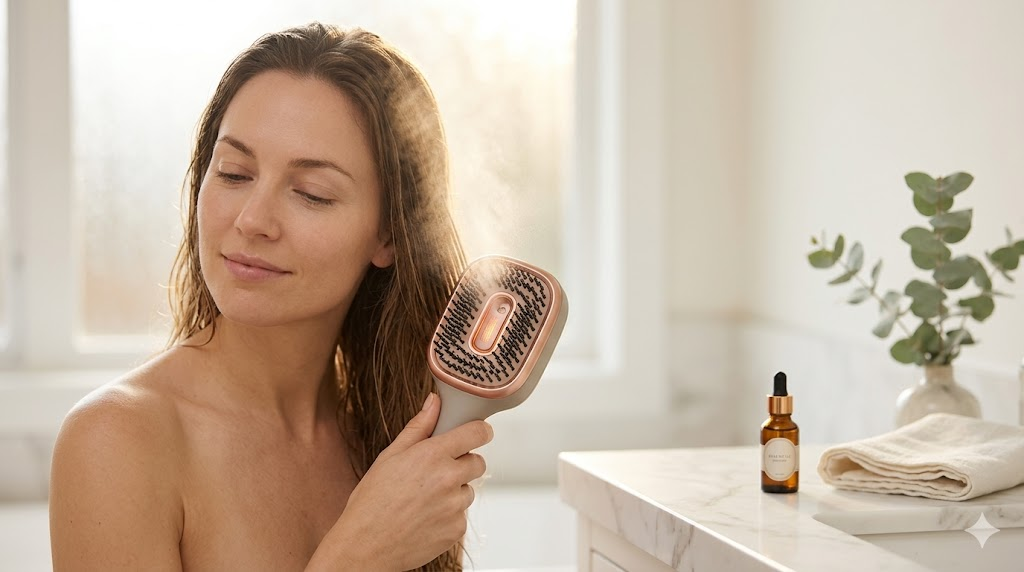
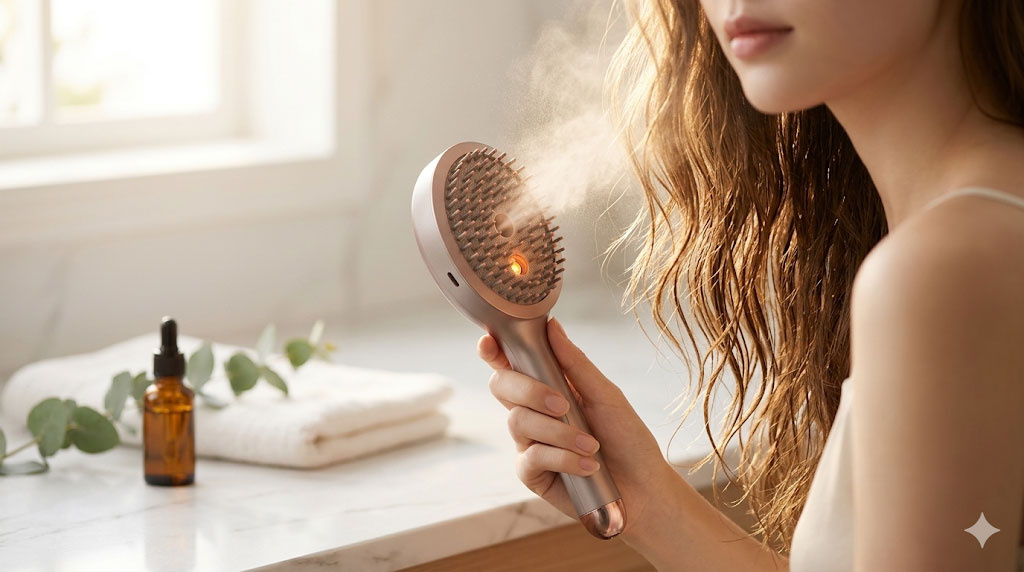
Nano-mist diffuser technology translates this principle to consumer scalp care. By generating a fine mist of sufficiently small droplets, these devices create even, full-scalp coverage — including the posterior regions that are almost impossible to reach with fingertips — while enhancing the probability that active ingredients are delivered to the follicular opening rather than dispersed across the hair shaft.
The practical result: the same serum you’ve been using costs you less (reduced waste), covers your scalp more evenly, and delivers its active ingredient to the correct anatomical target.
The Serum Comb: Simultaneous Delivery and Stimulation
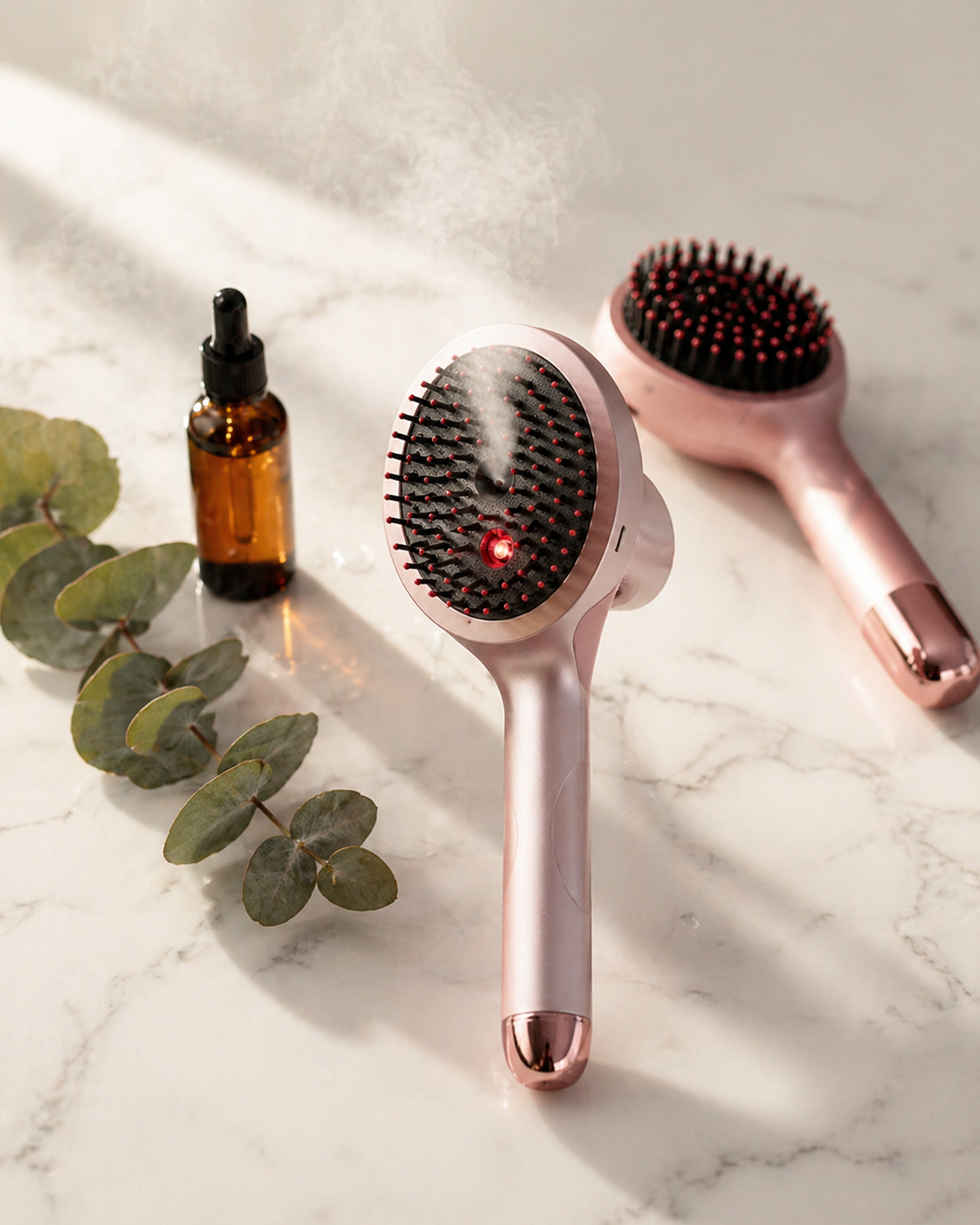
The second major delivery innovation is the precision serum comb — a device that combines a reservoir for liquid product with a delivery mechanism at the root of each tooth. As you comb through sections of hair, product is deposited directly at the scalp surface along the parting line — exactly where the follicular openings are.
The advantage over fingertip application is not just precision but mechanical stimulation. The act of combing with applied pressure along the scalp surface has been independently shown to increase local blood flow and stimulate mechanoreceptors in the follicular dermal papilla. Some serum comb devices incorporate red light (630–670nm) and microcurrent electrical stimulation into the same pass.
This matters because the evidence for each of these modalities — active delivery, mechanical stimulation, photobiomodulation, microcurrent — is independent and cumulative. Combining them in a single routine step is an application of the principle that scalp hair health is multi-factorial, and addressing multiple factors simultaneously is more effective than addressing one.
What High-Magnification Imaging Reveals About Why Serums “Don’t Work”
Here’s a revealing experiment dermatologists and scalp care specialists describe: image your scalp at 100–200x magnification before and after applying serum using your typical fingertip method. Then image it after applying the same serum using a nano-mist device.
What you consistently see in the first case: product residue on the hair shaft and between follicles, with follicular openings partially obscured. In the second: a much cleaner picture of accessible follicular openings, with product distributed at the surface level where it can enter.
More importantly: with regular imaging over time, the condition of the follicular ostia, the diameter of emerging hair shafts, and the density of vellus hairs at the hairline all become trackable data points rather than vague impressions. You stop guessing and start knowing.
Rootli Scope at 200x magnification turns your scalp into a dashboard. Most users describe their first scan as the moment their scalp care routine became intentional rather than habitual.
Steam Conditioning: Why Your Hair Mask Isn’t Penetrating
The same delivery logic applies to conditioning treatments. The hair cuticle — the overlapping scale-like cells that form the outer layer of each hair shaft — must be lifted for conditioning agents to penetrate the cortex where structural repair occurs.
Room-temperature mask application leaves the cuticle largely closed. Heat opens it. This is why professional salon treatments involve heated conditioning caps or steamer hoods as a standard step. The same mask applied with heat penetrates 3–5x more effectively than cold application.
For color-treated, heat-damaged, or chemically processed hair — where the cuticle structure is already compromised — this difference between heat-assisted and cold conditioning is especially dramatic. The consumer equivalent is a steam conditioning cap that generates consistent, gentle steam (typically 40–45°C) during the treatment period.
A Framework for Actually Effective Scalp and Hair Care
The effectiveness of your hair care routine is less about which active ingredients you’re using and more about whether your routine addresses these four pillars:
VISIBILITY: Can you see your scalp well enough to know what you’re addressing? If you can’t assess, you can’t track progress.
DELIVERY: Are your active products reaching the follicle, or the hair shaft? The answer changes everything.
STIMULATION: Is there a mechanical and/or photochemical signal prompting the follicle to respond? Passive application achieves less than active delivery.
RESTORATION: For the fiber itself — is structural repair actually being enabled, or just applied to the surface?
Most existing routines address one or two of these pillars. The gap between a routine that addresses all four and one that addresses one explains the difference between spending more on products and actually getting better results.